

How Unified ERP and CRM Drive Growth, Operational Control, and Customer Experience
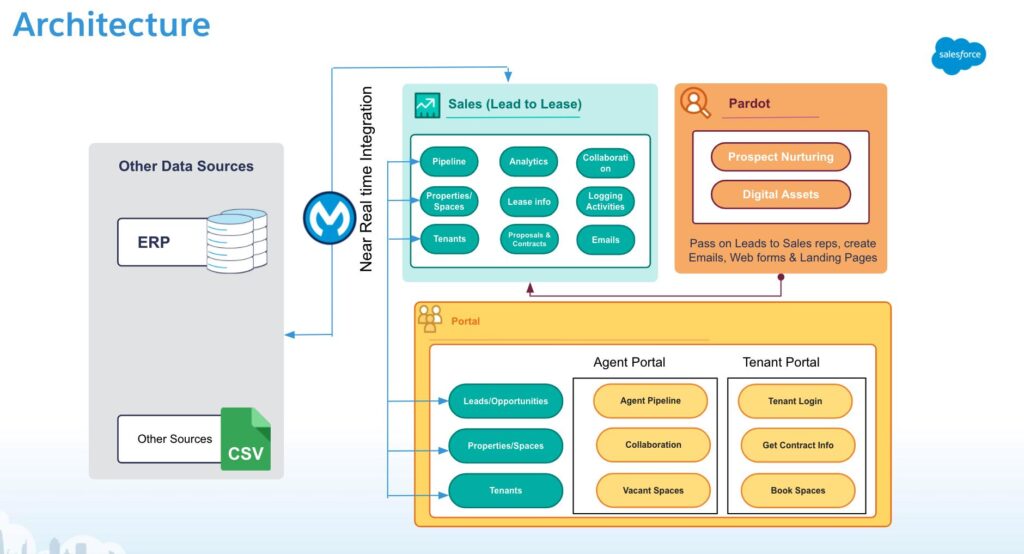
The enterprise real estate industry is no longer driven only by location, inventory, and sales relationships. Modern real estate organizations—whether developers, brokers, property management groups, or mixed-use asset operators—manage highly complex business ecosystems involving property inventory, sales pipelines, contracts, finance, leasing, maintenance, vendor management, and customer servicing.
As companies scale across multiple cities, regions, and business units, disconnected systems become one of the biggest barriers to growth.
Many enterprise real estate firms already use CRM platforms such as Salesforce to manage leads, sales teams, and customer engagement. At the same time, they require a powerful ERP system such as Odoo to manage finance, procurement, inventory, operations, HR, and compliance.
The challenge arises when these two systems operate independently.
Sales teams may close deals in Salesforce, while finance teams manually re-enter the same data into Odoo for invoicing, payment tracking, commission calculation, and reporting. This duplication creates delays, errors, and poor visibility.
This is where Odoo–Salesforce integration becomes a strategic advantage.
Why Enterprise Real Estate Companies Need ERP + CRM Integration
A large real estate company typically operates through multiple departments:
- Sales
- Marketing
- Leasing
- Finance
- Procurement
- Property Operations
- Facility Management
- Customer Service
- Legal & Contracts
- Executive Leadership
Each department depends on data generated by another.
For example, marketing generates leads. Sales converts leads into bookings. Finance issues invoices. Legal prepares contracts. Property management handles handover and post-sale services.
If data is fragmented, operational bottlenecks become unavoidable.
Common challenges include:
Lead-to-Sale Disconnect
Sales teams track opportunities in Salesforce, but booking confirmation is handled elsewhere. This causes incomplete sales reporting.
Inventory Visibility Problems
Agents may sell units without real-time visibility of unit availability, reservation status, or pricing changes.
Slow Booking & Contract Processing
Manual data transfer between CRM and ERP increases deal closure time.
Payment Collection Delays
Finance teams struggle to track installment schedules and outstanding payments.
Commission Errors
Broker and agent commissions become difficult to calculate accurately.
Poor Executive Reporting
Leadership lacks a single source of truth across sales and operations.
What Salesforce Handles Best in Real Estate
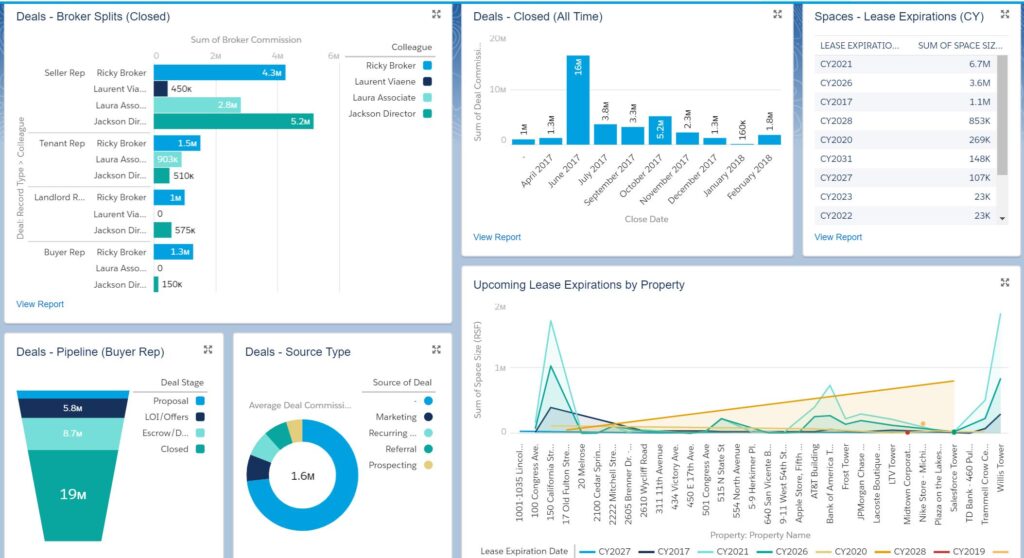
Salesforce excels at front-office customer engagement.
For enterprise real estate companies, Salesforce typically manages:
Lead Management
Capturing leads from:
- Website forms
- Portals
- Walk-ins
- Call centers
- Social media campaigns
- Broker networks
Opportunity Pipeline
Tracking deal stages such as:
Lead → Qualified → Site Visit → Negotiation → Reservation → Booking → Closed Won
Customer Relationship Management
Managing:
- Buyers
- Investors
- Tenants
- Corporate clients
- Brokers
Sales Automation
Salesforce automates:
- Follow-ups
- Email workflows
- Appointment reminders
- Agent assignments
Customer Journey
Monitoring customer interactions throughout the sales lifecycle.
In short, Salesforce helps maximize revenue generation.
What Odoo ERP Handles Best in Real Estate
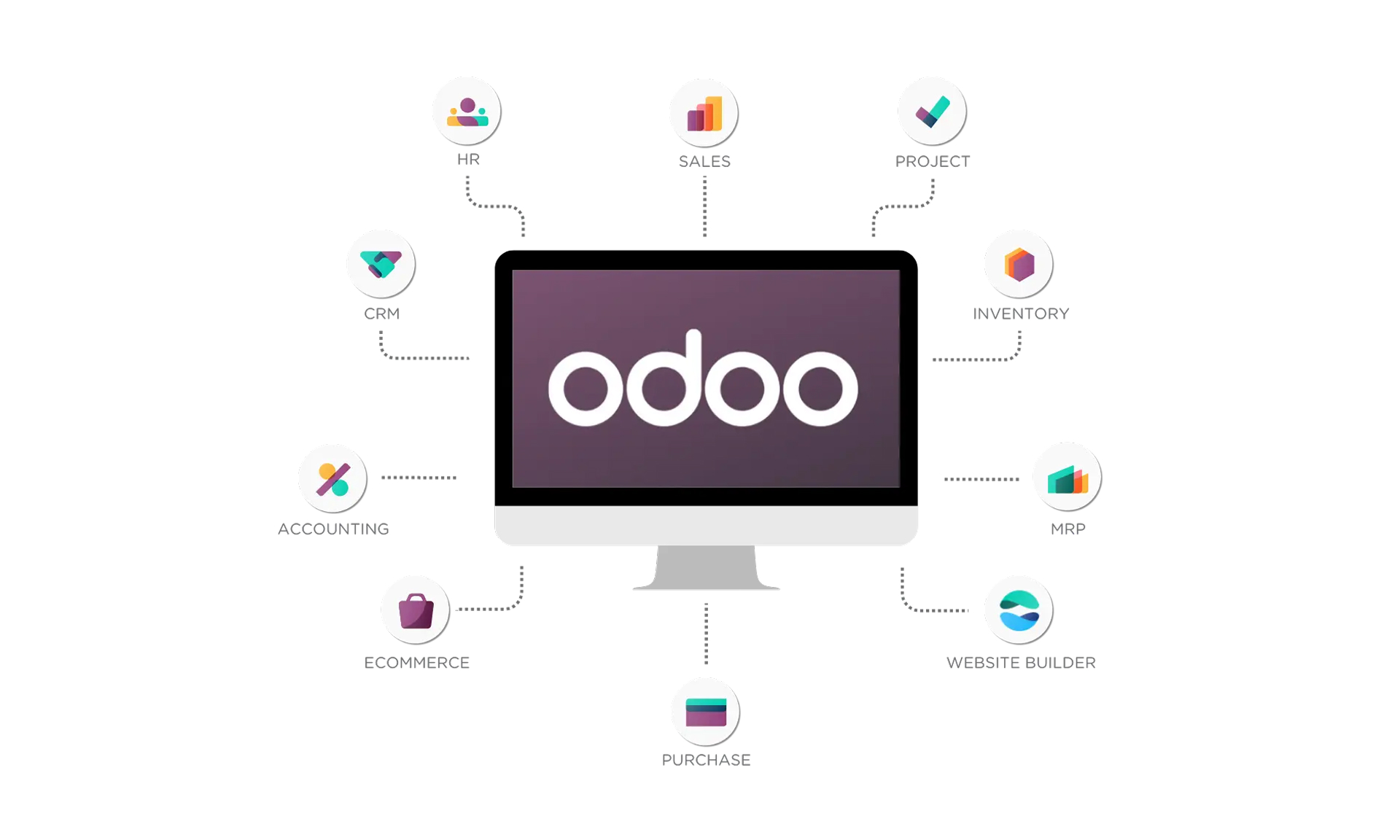
Odoo excels at back-office operational control.
In enterprise real estate, Odoo manages:
Financial Accounting
- Accounts receivable
- Accounts payable
- Tax management
- Cash flow
- Revenue recognition
Procurement
Managing vendor purchases for:
- Construction materials
- Facility supplies
- Maintenance services
Inventory & Assets
Tracking:
- Construction inventory
- Furniture
- Equipment
- Fixed assets
Contract Billing
Managing installment schedules, lease billing, and payment reminders.
HR & Payroll
Managing employees, agents, commissions, payroll, and expenses.
Maintenance & Service
Handling work orders, maintenance tickets, and SLA monitoring.
Odoo ensures operational efficiency and financial control.
The Real Power: Salesforce + Odoo Integration
The real transformation happens when Salesforce and Odoo communicate automatically.
Instead of multiple disconnected systems, businesses operate through synchronized workflows.
Integrated Architecture
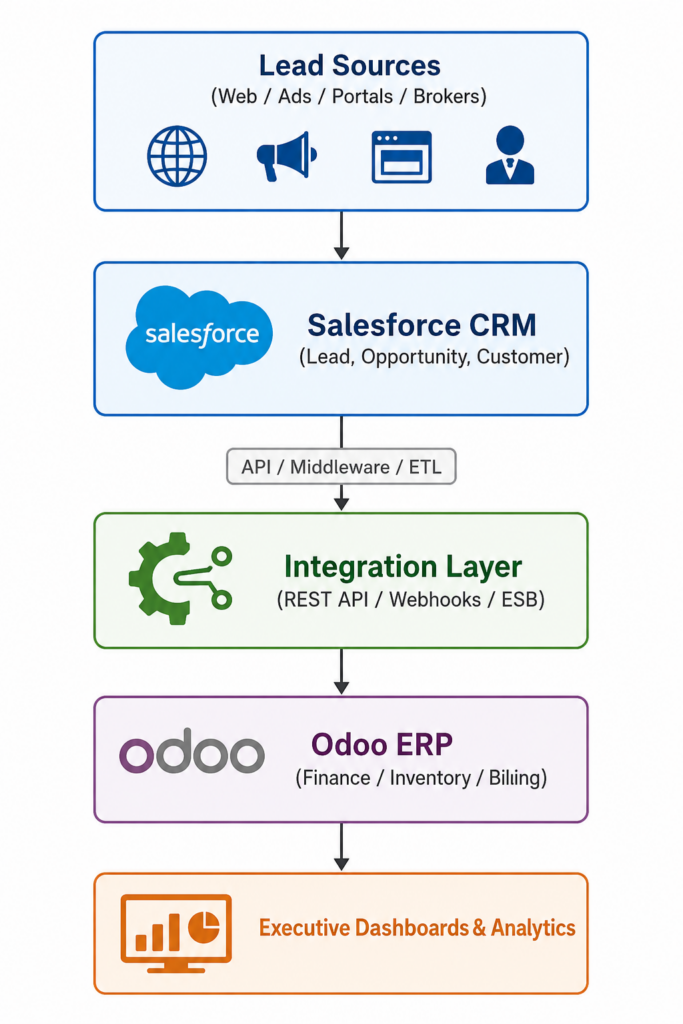
End-to-End Workflow in Enterprise Real Estate
Let us examine a typical enterprise workflow.
Step 1 — Lead Capture in Salesforce
A customer visits a property portal and submits interest for a luxury apartment.
Salesforce automatically creates:
- Lead record
- Source attribution
- Assigned agent
- Communication history
Sales team begins engagement.
Step 2 — Opportunity Qualification
The customer schedules a site visit.
Salesforce tracks:
- Preferences
- Budget
- Unit type
- Probability of closure
The opportunity progresses through the pipeline.
Step 3 — Unit Reservation
Agent reserves Unit A-1205.
At this stage, Salesforce checks Odoo inventory in real time.
Odoo confirms:
- Unit availability
- Reservation status
- Current pricing
- Discount rules
This prevents duplicate sales.
Step 4 — Booking Confirmation
Once customer confirms booking:
Salesforce triggers automated ERP transaction.
Odoo creates:
- Customer master record
- Booking order
- Payment schedule
- Contract reference
No manual data entry required.
Step 5 — Invoice Generation
Finance team receives automatic booking data.
Odoo generates:
- Down payment invoice
- Installment schedule
- VAT invoice
- Payment reminders
This reduces finance workload dramatically.
Step 6 — Payment Tracking
As payments are received:
Odoo updates:
- Paid amount
- Outstanding balance
- Overdue status
That status syncs back to Salesforce.
Sales agents instantly know payment health.
Step 7 — Handover & Post-Sales Service
After full payment:
Odoo triggers:
- Handover workflow
- Asset transfer
- Warranty registration
- Maintenance ticket setup
Customer service teams remain informed.
Critical Integration Modules for Real Estate
The most valuable integration points include:
Property Inventory Synchronization
Real-time sync of:
- Unit availability
- Floor plans
- Prices
- Reservation status
Customer Master Sync
Single customer profile across CRM and ERP.
Contract Synchronization
Sales contract and legal documents linked to financial records.
Payment Schedule Sync
Installments tracked across both platforms.
Broker Commission Automation
Automatic commission calculation based on sales milestones.
Service Ticket Integration
Post-sales support requests flow between systems.
Business Benefits of Odoo + Salesforce Integration
1. Single Source of Truth
Executives no longer depend on spreadsheets.
Every department accesses synchronized data.
2. Faster Sales Cycle
Sales agents spend less time chasing finance and operations.
Deals close faster.
3. Reduced Manual Errors
Automated sync eliminates duplicate entry.
Common issues reduced:
- Wrong invoice amount
- Incorrect unit allocation
- Missing customer records
4. Better Cash Flow Management
Finance gets visibility into receivables.
Leadership can forecast revenue accurately.
5. Improved Customer Experience
Customers receive faster:
- Booking confirmations
- Invoices
- Payment reminders
- Handover updates
6. Executive Analytics
Integrated dashboards help leadership answer:
- Which projects sell fastest?
- Which brokers perform best?
- Where are payment delays?
- Which units remain unsold?
- What is projected revenue?
Integration Architecture Options
There are multiple technical approaches.
Direct API Integration
Salesforce APIs communicate directly with Odoo APIs.
Best for:
- Mid-sized enterprises
- Lower complexity
Advantages:
- Lower cost
- Faster deployment
Limitations:
- Limited scalability
Middleware Integration
Using middleware such as:
- MuleSoft
- n8n
- Zapier
Best for:
- Enterprise environments
- Complex workflows
Advantages:
- Better monitoring
- Retry handling
- Transformation logic
Enterprise Service Bus (ESB)
Best for large enterprises with:
- SAP
- Legacy systems
- Data warehouses
- Multi-region architecture
Ideal for large-scale digital transformation.
Security & Compliance Considerations
Enterprise real estate companies handle sensitive customer data.
Integration must include:
- Role-based access control
- Audit logs
- API security
- Data encryption
- Backup & disaster recovery
- Regulatory compliance
For GCC markets, VAT and local compliance are critical.
How Xibtech Delivers Odoo + Salesforce Integration
Xibtech Solutions specializes in enterprise digital transformation for real estate companies across the United Arab Emirates and Saudi Arabia.
Our engagement model includes:
Discovery & Process Mapping
We assess current workflows and pain points.
Architecture Design
We design scalable ERP-CRM integration architecture.
Custom Integration Development
API and middleware development tailored to business processes.
Data Migration
Secure migration from legacy systems.
Dashboard & Analytics
Executive reporting with real-time KPIs.
Support & Optimization
Continuous monitoring and optimization.


Leave feedback about this